
Tests, build, and documentation
The project stage answers the practical questions a newcomer asks: how is this built, how is it tested, what does it need, and where is it documented? Everything is read from files and manifests. Commands are detected, never run, unless you enable execution.
repodna show --section tests,build,documentation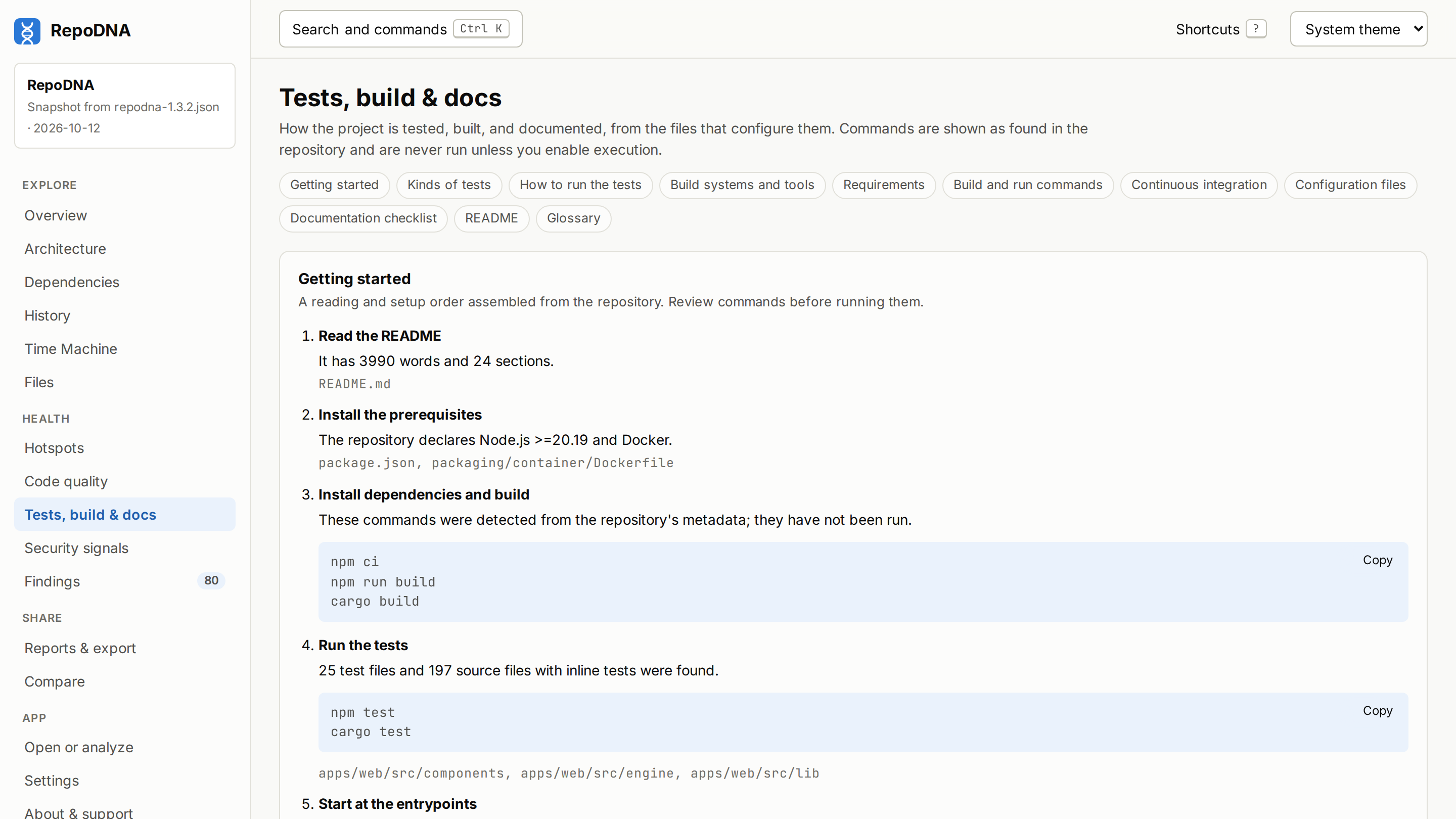
Tests#
- Test files are recognized by path and file-name conventions (
tests/,__tests__/,spec/,*_test.go,test_*.py,*.test.ts,*Test.java, and so on) and by inline test markers such as Rust#[cfg(test)]modules. - Frameworks are detected from dependencies, configuration files, and conventions, including Jest, Vitest, Mocha, Jasmine, AVA, Karma, Cypress, Playwright, Testing Library, pytest, unittest, Hypothesis, tox, nox, JUnit, TestNG, Kotest, Go testing, the Rust test harness, RSpec, Minitest, PHPUnit, Pest, xUnit.net, NUnit, MSTest, XCTest, GoogleTest, and Flutter test.
- Test commands come from package scripts, Makefiles, task runners, and ecosystem
conventions (
cargo test,go test ./...,npm test,pytest, ...). - Coverage reports that are committed are listed.
- CI: whether a CI configuration appears to run the tests.
The share of test code says where tests exist, not how much behavior they cover.
Rules: tests.none, tests.low-ratio, tests.not-in-ci, and tests.coverage-committed.
Build#
- Build systems and tools, including Cargo, npm, pnpm, Yarn, Vite, Rollup, Next.js, Nuxt, SvelteKit, Astro, Angular CLI, Nx, Turborepo, Lerna, Deno, Electron, Tauri, Go modules, Maven, Gradle, Poetry, Hatch, PDM, Pipenv, Flit, Maturin, Bundler, Rake, Composer, Dart pub, Flutter, Swift Package Manager, Xcode, CMake, Meson, Autotools, Make, Bazel, SCons, Nix, Just, and Task.
- Commands for installing, building, testing, linting, formatting, running, starting a
development server, and benchmarking, each
with its source (for example
web/package.json scripts.buildorMakefile test) and the directory it runs in. - CI systems: GitHub Actions, GitLab CI, CircleCI, Azure Pipelines, Jenkins, Travis CI, Bitbucket Pipelines, Drone, and Buildkite, with their job names.
- Containers: Dockerfiles and Compose files.
- Environment requirements: toolchains, runtimes, SDKs, and package managers declared
by the project, such as a Rust or Go version, Node.js
engines, orrequires-python.
Rule: build.no-ci.
Running commands#
RepoDNA can run the detected commands to check that they work, but only when you allow it
in your user configuration (a repository's repodna.toml cannot):
[execution]
allow_build_commands = true   # the first detected install command, then the first build command
allow_test_commands = true    # the first detected test command
timeout_seconds = 600
max_output_lines = 200- Commands run in the repository without a shell: the command line is split on whitespace,
and
&&chains run step by step. Commands that use other shell operators (pipes, redirections,;, and so on) are refused. - Each run has a time limit, stops when you cancel, runs non-interactively (
CI=true, no standard input), and keeps only the last lines of output, with likely secrets redacted. - A command that succeeds is marked verified; a failure is reported with its exit code and the end of its output. If installing fails, building is not attempted.
- The commands run with your permissions and can do anything the repository's build can do, including downloading packages and writing files into the checkout. Enable execution only for repositories you trust.
Documentation#
RepoDNA checks for the documents a project usually needs, and reads the README:
| Check | Looks for |
|---|---|
| README | A README at the root, with its length, headings, code blocks, links, and images |
| License | A license file or a license declared in a manifest, identified by SPDX identifier when possible |
| Installation and usage instructions | README sections about installing and using the project |
| Contributing guide, Code of conduct, Security policy, Changelog, Support information | CONTRIBUTING, CODE_OF_CONDUCT, SECURITY, CHANGELOG, and SUPPORT files |
| Code owners, Citation file | CODEOWNERS and CITATION files |
| Documentation directory, Examples | A docs/ directory and an examples/ directory |
| Issue templates, Pull request template | Templates in .github/ |
The documentation dimension of the DNA fingerprint is the share of these checks that are met.
Rules: docs.readme-missing, docs.readme-short, docs.setup-instructions,
docs.license-missing, docs.license-file-missing, and docs.optional-missing.