
Git history and code archaeology
When the input is a Git repository, RepoDNA reads its history to answer questions that the files alone cannot: how the project grew, who worked on what, what changes most, and how active it is now.
repodna history
repodna hotspots
repodna show --section history,contributors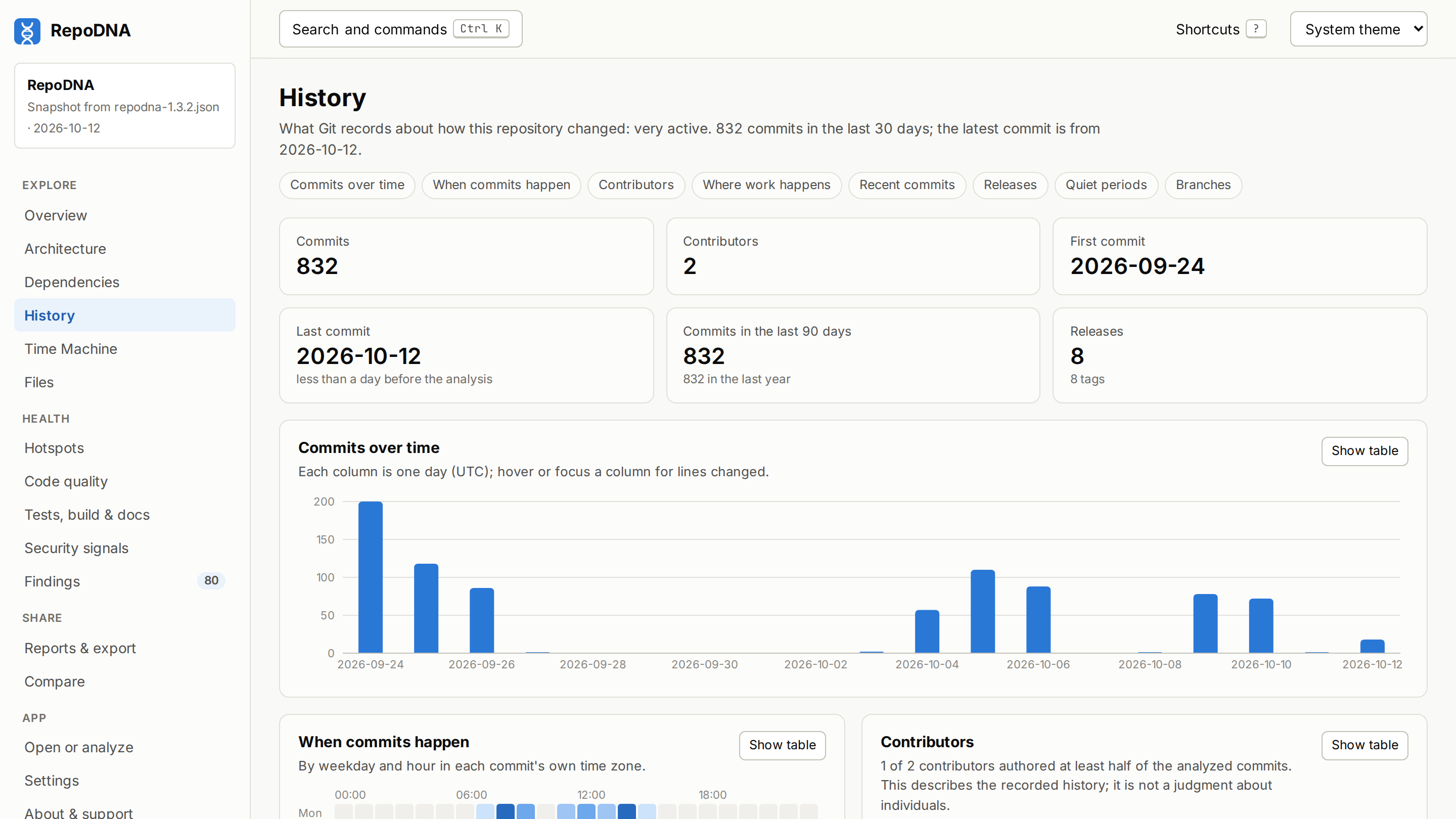
How history is read#
RepoDNA runs the git executable, read-only, through a hardened
runner: it streams git log with raw changes and
line counts in one pass, and reads branches, tags, and remotes separately. It does not
link a Git library, so it supports every repository format your Git supports. Without Git,
the history sections are marked unavailable and the rest of the analysis still runs.
- Which commits: those reachable from
HEAD, newest first, up toanalysis.max_commits(50,000 by default;--max-commitsfor one run). If the limit is reached,git.historyTruncatedis set and reports say so. - Shallow clones (for example CI checkouts with
fetch-depth: 1) are detected and flagged withgit.shallow; history-based results then describe only the fetched commits. For a full picture, analyze a full clone. - Merge commits are counted but carry no file changes of their own.
- Renames are followed, so a file's history continues across moves.
- Identities are grouped by e-mail address after applying the repository's
.mailmap. - The artifact stores up to
analysis.artifact_commits(1,000) commits with hash, date, author, and subject; statistics use every analyzed commit.
Everything that should not depend on when you run the analysis (recent churn, "recent" windows) is measured backwards from the latest commit, so the same revision always gives the same numbers. Only the activity level, which answers "is it active now?", is measured against the analysis time, and the artifact records that time.
What it reports#
| Result | Meaning |
|---|---|
| Timeline | Commits, authors, and lines added and removed per month, and commits per day. Histories shorter than three months are charted per day; reports chart long histories per quarter or year. |
| Contributors | Per identity: commits, lines added and removed, first and last commit, active days, and main areas. |
| Ownership | Share of commits by the top contributor, and how many contributors authored half of all commits. |
| Activity level | very-active (at least 30 commits in the last 30 days), active (at least 5), moderate (at least one in 90 days), low (at least one in 365 days), or dormant. |
| Releases | Tags that look like versions (v1.2.3, 2.0, v1.0.0-rc.1), with their dates and the commits between them. |
| Dormant periods | Gaps without commits of at least dormant_days (90). |
| File history | Per file: commits, authors, lines added and removed, when it first appeared and last changed, and earlier paths. |
| Hotspots | Files that change often and are complex; see below. |
| Recent changes | What changed in the recent_days (90) before the latest commit: commits, files, directories, and dependency changes. |
Hotspots#
A hotspot is a file where change and complexity meet: code that is modified often and is
hard to modify safely. Files changed in at least hotspot_min_commits (3) commits are
ranked by a weighted sum of percentile ranks:
| Signal | Weight |
|---|---|
| Commits touching the file | 30% |
| Churn (lines added and removed) | 20% |
| Commits in the recent window | 15% |
| Highest function complexity | 15% |
| Code lines | 10% |
| Distinct authors | 5% |
| Files that import it | 5% |
Each hotspot lists the signals that put it there, such as "Changed in 42 commits" or "Contains a function with complexity 31". See also complexity.
People#
History describes how a repository was worked on, not the quality of anyone's work. RepoDNA reports identities and their commits, never judgments about people. Squash merges, pair programming, bots, and people using several e-mail addresses all distort attribution.
--anonymize(orprivacy.anonymize_contributors) replaces names with "Contributor 1", "Contributor 2", and so on in the artifact.--no-commit-messages(orprivacy.include_commit_messages = false) keeps commit subjects out of the artifact.--privacy publicreplaces names with pseudonyms in reports and exports.
See privacy.
Findings#
activity.hotspot, activity.high-churn-area, contributors.concentration,
evolution.dormant-period, evolution.abandoned-area, and evolution.new-module; see
the rules reference. For how the repository changed over time,
see the Time Machine.