RepoDNA: Turning a Software Repository into a Living Project DNA
RepoDNA is an open-source repository intelligence and codebase archaeology project designed to help developers understand how a software project is structured.
RepoDNA: Turning a Software Repository into a Living Project DNA
Software repositories contain far more information than the source code that appears inside their files.
A repository tells a story.
It contains the structure of a project, the relationships between modules, dependencies between components, development history, architectural decisions, changes made over time, releases, complexity, and countless small signals that can help explain how the project became what it is today.
The problem is that much of this information is scattered across directories, source files, configuration files, dependency manifests, Git commits, branches, pull requests, releases, and documentation.
That is where RepoDNA comes in.
RepoDNA is an open-source repository intelligence and codebase archaeology project designed to help developers understand the deeper structure and evolution of software repositories.
Instead of looking at a repository as simply a collection of files, RepoDNA explores the idea of treating it as a living system with its own Project DNA.
🔗 GitHub: https://github.com/sanskarIN/RepoDNA
🌐 RepoDNA Website: https://sanskarin.github.io/RepoDNA
👨💻 GitHub Profile: https://github.com/sanskarIN
🌐 Main Website: https://sanskarin.github.io/
What Is RepoDNA?
RepoDNA is built around a simple idea:
A repository should be understandable as a system, not just browsed as a folder.
Opening a large project for the first time can be overwhelming.
You may see hundreds or thousands of files.
There may be multiple applications, libraries, packages, services, utilities, tests, configuration directories, generated files, documentation, CI workflows, scripts, and other components.
A directory tree tells you where files are.
RepoDNA is intended to help answer deeper questions such as:
- How is this repository organized?
- Which components are connected?
- What are the major architectural areas?
- Which dependencies are important?
- How has the project changed?
- Which parts of the project have evolved most?
- What does the repository's history tell us?
- How complex is the codebase?
- What makes this project structurally unique?
- How can someone understand the project faster?
The goal is to move from simple repository browsing toward repository intelligence.
Why I Started RepoDNA
One of the biggest challenges when working with existing software is not always writing new code.
Sometimes the hardest part is understanding code that already exists.
When developers join an unfamiliar project, contribute to an open-source repository, inherit an old codebase, review an architecture, or investigate a project after several years of development, they often have to spend significant time reconstructing the project's internal story.
They need to inspect directories.
Then source files.
Then dependency definitions.
Then configuration.
Then documentation.
Then Git history.
Then commits.
Then releases.
Then relationships between everything.
This process is often called code archaeology or software archaeology.
The idea behind RepoDNA is to make that process more systematic.
Instead of forcing a developer to manually reconstruct the complete story of a project, RepoDNA aims to bring important signals together into a coherent representation of the repository.
The Idea of Project DNA
Every software project develops its own characteristics.
Two repositories can both contain thousands of lines of code and still have completely different structures.
One might be a tightly coupled monolithic application.
Another could be a collection of independent packages.
One project might have a long and stable history.
Another might have undergone major architectural changes.
One repository may have a large dependency graph.
Another may intentionally minimize dependencies.
These characteristics form what I think of as a project's DNA.
RepoDNA is intended to capture that DNA through information such as:
Architecture
How the repository is divided and how its major components relate to one another.
Dependencies
What libraries, packages, modules, and external components the project relies on.
Complexity
Signals that help describe how complicated different portions of the project may be.
Git History
The timeline of development and how the repository changed over time.
Evolution
How structures, components, and code patterns developed throughout the project's lifetime.
Repository Structure
The organization of files, directories, packages, modules, and other project components.
Project Intelligence
A combined perspective that can help a developer understand the repository without manually inspecting every part.
Repository Intelligence Instead of File Browsing
Traditional repository exploration usually begins with a familiar process:
Open the repository.
Open a directory.
Open another directory.
Open a source file.
Search for references.
Check dependencies.
Search through Git history.
Repeat.
This approach works, but it can become increasingly difficult as projects grow.
A larger repository can have multiple layers of architecture and history that are not immediately visible from the directory tree.
RepoDNA explores another approach.
Instead of asking only:
"What files are inside this repository?"
we can ask:
"What is this repository?"
That distinction is at the heart of the project.
Codebase Archaeology
The phrase codebase archaeology describes an important part of modern software engineering.
Developers frequently work with codebases they did not originally create.
They may encounter:
- legacy projects
- abandoned projects
- long-running open-source projects
- inherited company software
- unfamiliar frameworks
- large monorepos
- projects with limited documentation
- rapidly evolving applications
In these environments, understanding history can be just as important as understanding current code.
A function may exist because of a historical requirement.
A strange dependency may have been introduced years ago.
A module may have been retained for compatibility.
A directory may represent an older architecture.
A seemingly unusual pattern may make sense when viewed through the project's development history.
This is why RepoDNA considers both structure and evolution important.
Git History as a Source of Intelligence
Git is not only a version-control system.
For repository analysis, Git can also provide a historical dataset describing how a project evolved.
Commits can reveal:
- when areas of the project changed
- which parts changed frequently
- how development progressed
- how releases were formed
- how architecture may have evolved
- which components have remained relatively stable
RepoDNA's broader vision is to make historical information part of repository understanding rather than something developers inspect only when troubleshooting.
A current snapshot tells us what the project looks like now.
History can help explain how it got there.
Understanding Dependencies
Dependencies are another major part of a project's identity.
Modern applications rarely exist in isolation.
A repository may depend on dozens or hundreds of external packages, libraries, frameworks, tools, or internal components.
Understanding those relationships can be useful when:
- onboarding contributors
- investigating architecture
- evaluating maintainability
- preparing migrations
- analyzing projects
- understanding security boundaries
- planning refactoring
- studying software evolution
RepoDNA aims to treat dependency information as part of the larger Project DNA rather than as an isolated package list.
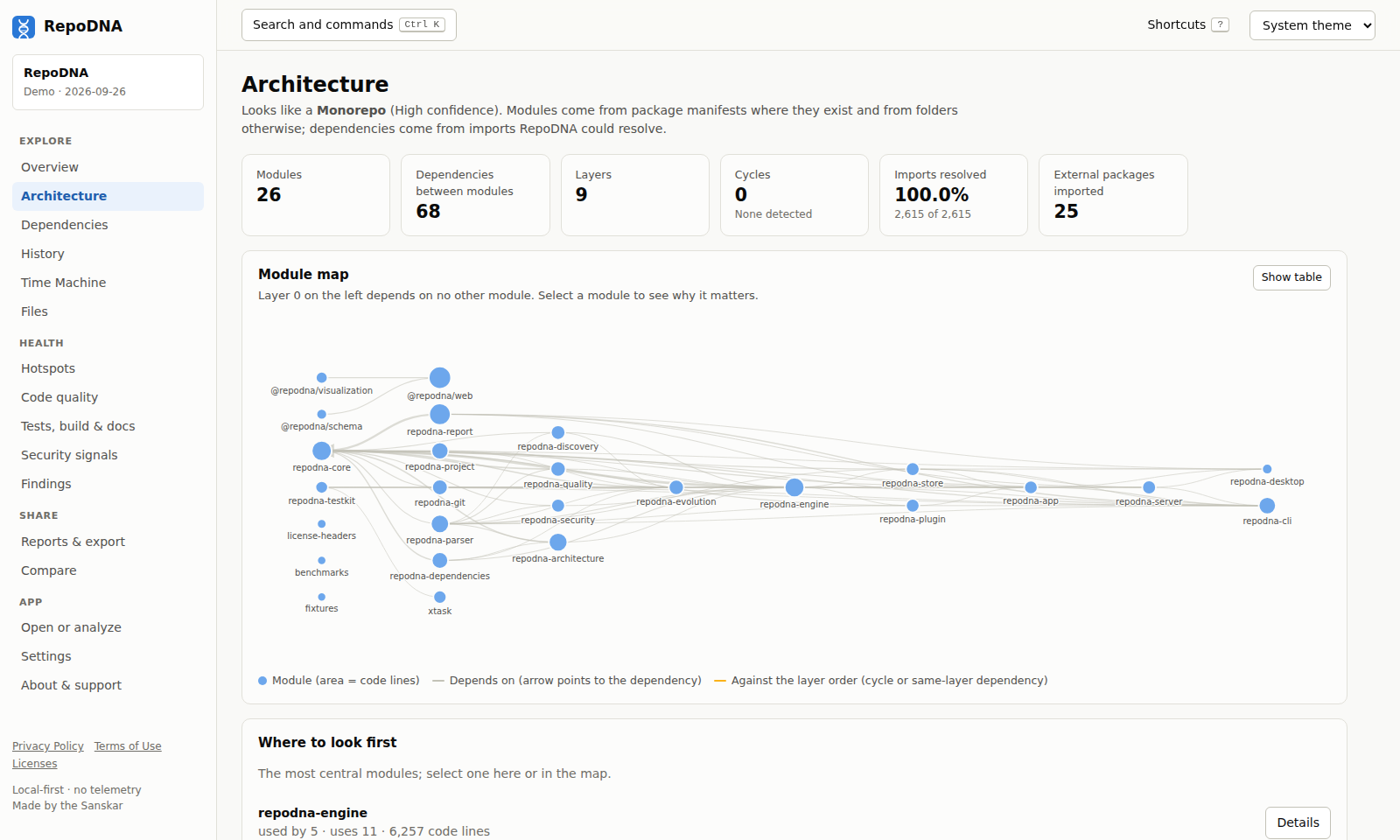
Architecture Discovery
Architecture can be difficult to understand from source code alone.
A repository may contain multiple architectural layers, for example:
Application
├── UI
├── Services
├── Domain
├── Data
├── Infrastructure
└── Tests
But real-world repositories are often considerably more complex.
There may be shared libraries, cross-module dependencies, generated code, tooling, plugins, integrations, scripts, and multiple applications living inside one repository.
An architecture-oriented view can help transform that complexity into something easier to reason about.
One of the long-term directions of RepoDNA is to make architecture discovery more visible and understandable.
Complexity Matters
Not every part of a repository is equally difficult.
Some components may be tiny and straightforward.
Others may contain complicated interactions, large dependency networks, or significant historical activity.
Understanding complexity can help developers decide where to investigate first.
RepoDNA therefore considers complexity analysis an important part of its repository intelligence direction.
The goal is not simply to produce a number.
The more useful goal is to provide context.
A metric becomes much more meaningful when it can be connected to:
- a component
- a module
- a dependency
- a historical trend
- an architectural relationship
- or a specific area of the repository
From Repository to Project DNA Report
One of the ideas behind RepoDNA is the creation of a Project DNA report.
Instead of requiring someone to inspect many different sources of information separately, the report can bring them together into one representation.
A Project DNA report could describe things such as:
Project
├── Repository Structure
├── Architecture
├── Components
├── Dependencies
├── Complexity
├── Git History
├── Evolution
├── Activity
└── Project Characteristics
This creates a higher-level view of the repository.
The objective is not to replace source code.
It is to provide a layer of intelligence above the source code.
Who Could Use RepoDNA?
RepoDNA is intended for a broad range of developers and software-engineering workflows.
Open-Source Contributors
When discovering an unfamiliar open-source repository, RepoDNA can provide a starting point for understanding the codebase and its structure.
Maintainers
Maintainers can use repository intelligence to better understand how their projects evolve and how different areas are connected.
Developers
Developers working with existing codebases can use structural and historical information during exploration and debugging.
Students and Learners
Large production repositories can be difficult learning environments. A higher-level representation can make them easier to study.
Researchers
Repository history and structural information can provide useful material for software-engineering research and experimentation.
Teams
Engineering teams can use repository analysis during architecture discussions, migrations, onboarding, and technical planning.
Why Open Source?
RepoDNA is an open-source project.
That is an important part of the project's identity.
Repository intelligence should not be limited to a proprietary black box.
Open-source software allows developers to inspect the implementation, experiment with it, create issues, suggest improvements, build integrations, and contribute new ideas.
The GitHub repository is available publicly:
https://github.com/sanskarIN/RepoDNA
The project website is also available publicly:
https://sanskarin.github.io/RepoDNA
The Technology Direction
RepoDNA is being developed with a modern developer-tooling architecture in mind.
The project direction includes technologies such as:
Rust
Rust is a major part of the technical direction because repository analysis can involve processing large amounts of structured information efficiently.
Rust also provides strong foundations for building reliable developer tools and command-line or local analysis systems.
TypeScript
TypeScript can provide a productive environment for building interfaces and application-layer functionality around repository intelligence.
React
React can be used for interactive experiences that visualize repository information and make complex data easier to explore.
Local Analysis
A major idea behind RepoDNA is that repository analysis can happen locally wherever practical.
This can be useful for developer workflows where source code should remain on the developer's machine.
AI — Future Direction
AI is also part of the longer-term vision.
Rather than making AI the only component of RepoDNA, the idea is to use AI where it can add useful context on top of structured repository analysis.
That could include areas such as:
- architecture explanations
- codebase questions
- repository summaries
- historical interpretation
- relationship discovery
- intelligent exploration
The underlying repository data remains important because AI becomes more useful when it has structured information about the codebase.
Windows and Cross-Platform Development
RepoDNA is designed with modern developer environments in mind.
Windows is an important development environment, especially for developers using tools such as:
- Git
- Visual Studio Code
- Rust
- Node.js
- TypeScript
- React
- PowerShell
- Windows Terminal
At the same time, the broader project direction is intended to remain relevant to developers working across Windows, Linux, and macOS.
Developer tools become more useful when they can fit naturally into existing workflows rather than forcing developers to completely change how they work.
A Local-First Possibility
There is also an interesting opportunity around a local-first repository intelligence workflow.
Source code can be highly sensitive.
Developers may be working with:
- private projects
- commercial software
- unreleased products
- internal tools
- proprietary algorithms
- client projects
For those scenarios, running analysis locally can be particularly valuable.
A future RepoDNA workflow could allow a developer to point the tool toward a repository and generate useful intelligence without automatically uploading the complete codebase to a remote service.
That direction can provide a strong foundation for privacy-conscious developer tooling.
RepoDNA Is More Than a Repository Tree
A directory tree answers one question:
What is here?
RepoDNA aims to explore several additional questions:
How is it organized?
How are the components connected?
What does it depend on?
What changed?
How did it evolve?
Where is complexity concentrated?
What does the history tell us?
What is the overall character of this project?
These questions create a much richer representation of a software repository.
The Long-Term Vision
The long-term vision for RepoDNA is much larger than generating a static report.
I want RepoDNA to evolve toward a complete repository intelligence layer.
That could include:
Repository Discovery
Automatically identify important structures and components.
Architecture Mapping
Represent major relationships within the project.
Historical Analysis
Understand how the repository evolved.
Dependency Intelligence
Map internal and external dependencies.
Complexity Analysis
Identify areas that deserve deeper investigation.
Project DNA
Create a recognizable high-level representation of each repository.
Interactive Exploration
Allow developers to navigate repository intelligence rather than simply reading a static report.
AI-Assisted Understanding
Allow developers to ask questions about their repository using the project's actual structure and history as context.
Imagine Asking Your Repository Questions
One particularly interesting future direction is turning the repository itself into an interactive knowledge source.
Instead of manually searching through hundreds of files, a developer could eventually ask questions such as:
Which parts of the project are responsible for authentication?
What are the most interconnected modules?
How has this component evolved?
Which dependencies are used by this service?
What changed significantly during the last major development phase?
Which parts of the repository should I understand before modifying this module?
What is the architecture of this project?
The objective is to make repository exploration feel more like interacting with a knowledge system.
RepoDNA and Developer Experience
Developer experience is not only about making code easier to write.
It is also about making software easier to understand.
Good developer tooling can reduce the amount of mental reconstruction developers have to perform.
When joining an unfamiliar project, much of the initial work is understanding:
- terminology
- architecture
- dependencies
- conventions
- history
- workflows
- relationships
RepoDNA is an exploration of how tooling can assist with that process.
Learning From Real Repositories
One of the most interesting aspects of an open-source repository intelligence project is the opportunity to study real projects.
Different repositories can have completely different DNAs.
For example:
Repository A
→ Small
→ Few dependencies
→ Simple architecture
→ Short history

Repository B
→ Large
→ Many components
→ Complex dependency graph
→ Long development history

Repository C
→ Monorepo
→ Multiple applications
→ Shared packages
→ High architectural interconnectedness
A repository intelligence tool can help make those differences observable.
That creates opportunities not only for practical developer tooling, but also for learning and experimentation.
RepoDNA as a Developer Tool
At its core, RepoDNA is an experiment in building better developer tooling.
The project asks a simple question:
Can we understand software repositories more intelligently?
The answer is not supposed to come from one metric or one visualization.
It comes from combining multiple forms of evidence.
Source structure.
Dependencies.
Architecture.
Complexity.
Git history.
Evolution.
And eventually, intelligent interfaces that allow developers to explore all of those signals together.
Open Source and Community
RepoDNA is open source, and its future can benefit from contributions from developers with different interests.
Contributors can bring ideas from areas such as:
- Rust
- TypeScript
- React
- Git
- static analysis
- graph analysis
- software architecture
- developer tooling
- data visualization
- AI
- local-first applications
- documentation
- testing
- performance optimization
A repository intelligence project naturally touches many areas of software engineering, which makes it a particularly interesting space for collaboration.
Why I Think This Problem Is Interesting
Software projects are living systems.
They change.
They grow.
They accumulate dependencies.
They gain and lose components.
Their architecture evolves.
Their Git history records their development.
Their structure reflects decisions made by developers over time.
Yet most developer tools still require humans to manually connect many of these pieces.
RepoDNA is an attempt to explore what happens when we make those relationships a first-class part of repository tooling.
The Bigger Idea
The bigger idea behind RepoDNA is not simply:
"Analyze my repository."
It is:
"Help me understand this software system."
That distinction matters.
Analysis produces information.
Understanding connects that information into something meaningful.
RepoDNA is being built around that second goal.
What Comes Next?
RepoDNA is still an evolving project, and there is a large amount of room for experimentation.
Future development can explore areas such as:
- deeper repository analysis
- richer architecture discovery
- more detailed dependency graphs
- improved Git evolution analysis
- project intelligence reports
- interactive visualizations
- local AI integration
- repository question answering
- better developer workflows
- improved performance for large repositories
- additional language support
- cross-platform tooling
- contributor-focused features
The long-term objective is to keep pushing RepoDNA from a repository analyzer toward a broader repository intelligence platform.
Try RepoDNA
You can explore the project here:
GitHub
https://github.com/sanskarIN/RepoDNA
RepoDNA Website
https://sanskarin.github.io/RepoDNA
My GitHub
My Main Website
My Dev.to
Contributing
Because RepoDNA is open source, contributions, ideas, issues, discussions, documentation improvements, testing, and technical experimentation can all be valuable.
A project like this becomes more useful when it is tested against different kinds of repositories.
Small projects.
Large projects.
Libraries.
Applications.
Monorepos.
Command-line tools.
Web applications.
Desktop applications.
Systems software.
Experimental projects.
Real-world open-source repositories.
Every repository can reveal a different challenge.
Final Thoughts
A software repository is much more than a collection of files.
It is a history.
It is an architecture.
It is a dependency network.
It is a collection of decisions.
It is an evolving system.
And it contains a kind of identity.
RepoDNA is my attempt to make that identity easier to discover.
The project combines ideas around repository structure, codebase archaeology, Git history, dependencies, complexity, architecture, evolution, and future AI-assisted exploration into one open-source direction.
The ultimate goal is simple:
Make software repositories easier to understand.
Not just to browse.
Not just to search.
But to actually understand.
That is the idea behind RepoDNA.
And this is only the beginning.
Project Links
RepoDNA: https://github.com/sanskarIN/RepoDNA
RepoDNA Website: https://sanskarin.github.io/RepoDNA
GitHub: https://github.com/sanskarIN
Website: https://sanskarin.github.io/
Dev.to: https://dev.to/sanskarIN
X: https://x.com/dev_sanskarIN
Contact
Business: [sanskarin@outlook.in](mailto:sanskarin@outlook.in)
Business: [sanskarin.business@gmail.com](mailto:sanskarin.business@gmail.com)
Support: [supportramsandesh@gmail.com](mailto:supportramsandesh@gmail.com)
Tags
#RepoDNA #Rust #TypeScript #React #OpenSource #GitHub #DeveloperTools #CodeIntelligence #RepositoryAnalysis #CodebaseAnalysis #SoftwareArchitecture #Git #CodeArchaeology #DeveloperExperience #Programming #Windows #Linux #macOS #AI #LocalFirst #SoftwareEngineering #DevTools