repodna-v1-2-1-release
RepoDNA v1.2.1 is now available, bringing easier npm installation, better accessibility, improved mobile behavior, clearer Git errors, a restored Project DNA card, and more reliable web deployment.
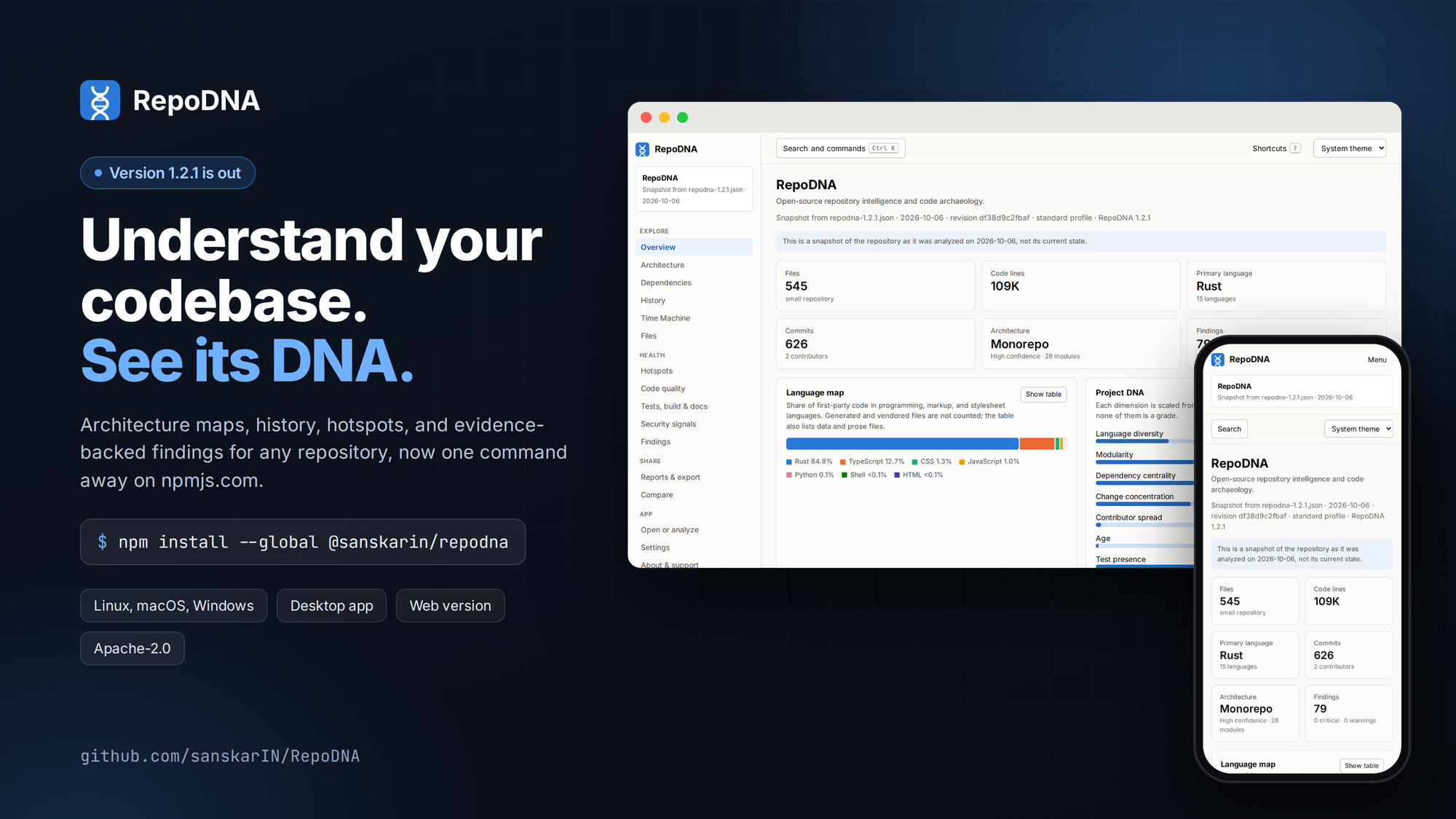
RepoDNA v1.2.1: Easier Installation and a More Polished Repository Intelligence Experience
Published October 6, 2026
RepoDNA v1.2.1 is now available.
This release focuses on making RepoDNA easier to install, more accessible, more usable on phones, and more reliable in everyday workflows.
RepoDNA is an open-source, local-first repository intelligence and code archaeology platform that turns a repository into an evidence-backed picture of its structure, architecture, dependencies, history, quality, security, tests, documentation, and evolution.
The biggest update: npm installation
RepoDNA packages are now available on npmjs.com as well as GitHub Packages.
That means you can install the command line with:
npm install --global @sanskarin/repodna@1.2.1
No GitHub token is required for the normal npm installation flow.
The release also publishes the RepoDNA schema and visualization packages through npm.
Better repodna serve
The local web interface continues to be one of the main ways to explore an analysis.
In v1.2.1, the Project DNA card is working again in repodna serve.
The start page also does a better job of explaining how repositories are analyzed and how the resulting repodna.json can be opened in the web interface.
Accessibility
v1.2.1 improves accessibility across both the web interface and generated HTML reports.
The improvements include better contrast, heading structure, landmarks, keyboard scrolling, and screen-reader descriptions for charts and other interface elements.
Mobile improvements
Long repository paths, commands and tables can be difficult to use on small screens.
v1.2.1 improves how those elements behave on phones, including better wrapping, horizontal table scrolling and visual indicators for content outside the current viewport.
Clearer errors
Git clone failures are now easier to understand.
RepoDNA reports the actual Git reason without exposing unnecessary command details and provides clearer guidance for common problems such as private repositories, missing repositories, or unreachable hosts.
More accurate recent-history analysis
The 90-day recent-history window used by repodna ci and onboarding now ends at the repository's latest commit.
That makes the result more meaningful when analyzing a repository that has been inactive for some time.
More reliable web deployment
The GitHub Pages deployment flow has also been improved so the web interface can be republished properly after Pages completes its build.
The workflow additionally warns when the Pages source is still configured from a branch rather than GitHub Actions.
A release built around refinement
v1.2.1 is not a large rewrite.
It is about removing friction from a project that is already capable of substantial repository analysis.
RepoDNA continues to provide:
- architecture and dependency analysis
- Git history and code archaeology
- change hotspots
- quality and complexity signals
- security signals
- tests, build and documentation analysis
- the Codebase Time Machine
- Project DNA cards and reports
- CLI, local web and desktop interfaces
- optional evidence-grounded AI explanations
The common theme is evidence.
RepoDNA is designed to show why something appears in an analysis rather than simply returning an unexplained score.
Install RepoDNA 1.2.1
npm install --global @sanskarin/repodna@1.2.1
Explore the project
Repository:
https://github.com/sanskarIN/RepoDNA
Release:
https://github.com/sanskarIN/RepoDNA/releases/tag/v1.2.1
Release notes:
https://github.com/sanskarIN/RepoDNA/blob/main/docs/releases/v1.2.1/README.md
Web version:
https://sanskarin.github.io/RepoDNA/
Media kit:
https://github.com/sanskarIN/RepoDNA/blob/main/docs/media/README.md
What's next?
RepoDNA's development continues toward making repository intelligence more useful for developers, maintainers, teams, and anyone who needs to understand an unfamiliar codebase.
For now, v1.2.1 is another step in that direction.
Understand your codebase. See its DNA.
— Sanskar