Building Software That Works Locally: Why the Next Generation of Apps Won’t Depend on the Cloud
Exploring how local-first AI can make apps faster, more private, and less dependent on the cloud.
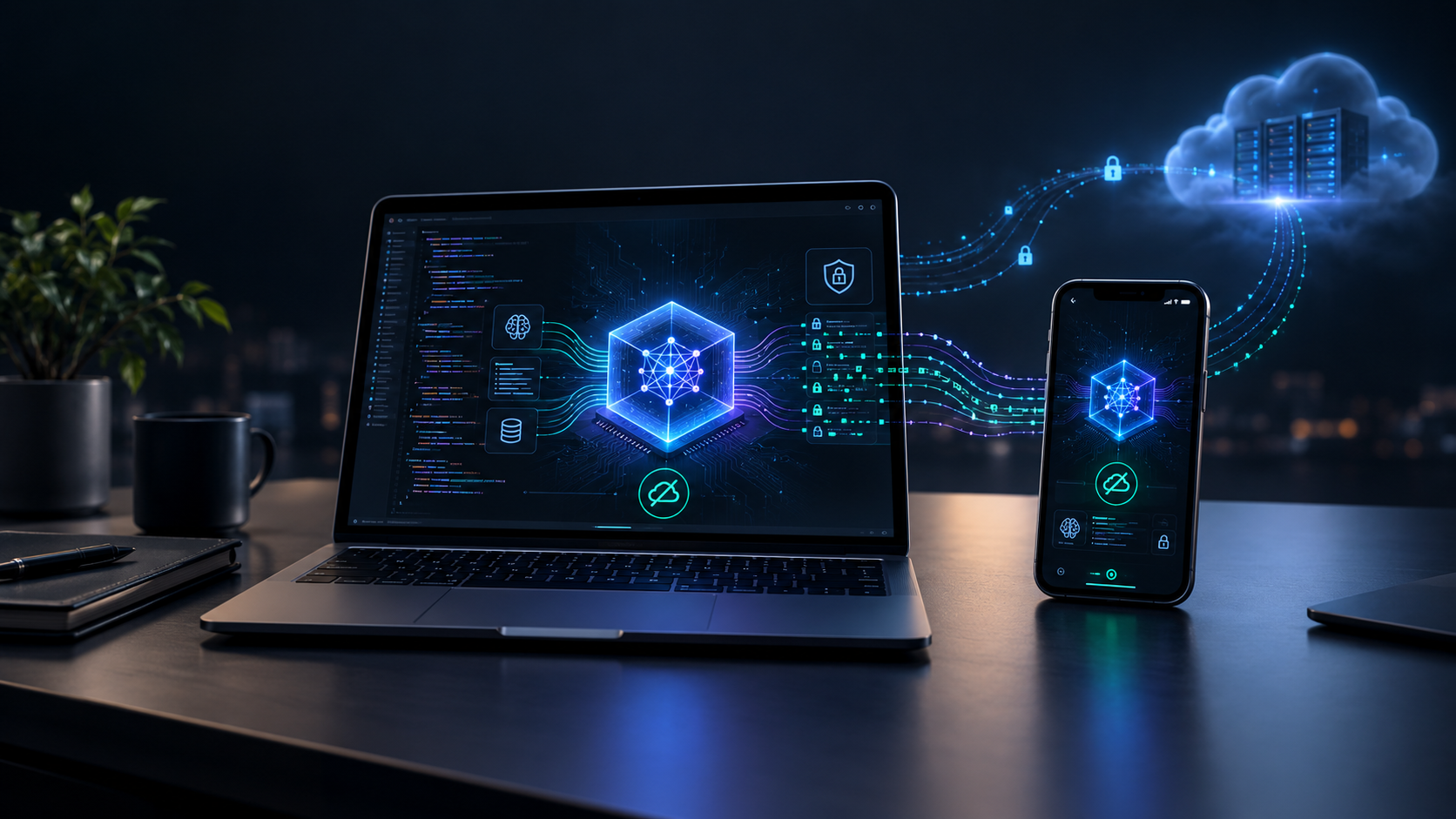
Building Software That Works Locally: Why the Next Generation of Apps Won’t Depend on the Cloud
Modern software has become incredibly powerful, but much of that power comes with a dependency: the cloud.
Open an AI application, synchronize your notes, process a document, generate an image, or analyze a large dataset, and there is a good chance that at least part of the operation depends on a remote server.
That model has worked remarkably well. Cloud computing gives developers access to huge amounts of computing power, centralized storage, scalable infrastructure, and increasingly capable AI models.
But there is another direction worth exploring.
What Changes When Software Can Work Locally?
A local-first application tries to make the device an important part of the computing system rather than treating it as nothing more than a window into the cloud.
Instead of sending every action to a remote service, some operations can happen directly on the user's machine.
For example:
- Data can remain on the device.
- Some AI inference can happen locally.
- Applications can continue working without an internet connection.
- Latency can be reduced because requests do not always need to travel to a server.
- Users can have more control over their own data.
This does not mean the cloud becomes unnecessary.
Instead, the relationship can change.
The cloud can become an enhancement rather than a requirement.
Local-First Does Not Mean Cloud-Free
One of the biggest misunderstandings around local-first software is the idea that everything must happen offline.
That is not necessary.
A practical application can use a hybrid architecture.
Simple or privacy-sensitive operations can happen locally, while more demanding operations can use cloud infrastructure when appropriate.
Imagine an AI application that processes a user's notes.
The application could perform search, indexing, basic classification, and lightweight inference locally.
A powerful cloud model could then be used only when the user requests a task that requires substantially more computation.
This architecture creates a different balance between privacy, performance, cost, and functionality.
The Device Becomes Part of the Intelligence
Modern phones and computers are no longer simple clients.
They contain increasingly capable CPUs, GPUs, NPUs, fast storage, and dedicated hardware for machine-learning workloads.
That creates an interesting opportunity for developers.
Instead of designing an application around the assumption that every intelligent operation belongs on a server, we can ask another question:
What can this device already do well?
That question can completely change the architecture of an application.
A local-first AI application might use the device for:
Storage
User data can be stored locally rather than automatically uploading everything to a remote database.
Search
Local indexes can provide fast searching without requiring a network request for every query.
Inference
Smaller optimized models can handle selected AI tasks directly on the device.
Caching
Frequently used information can remain available even when connectivity is limited.
Processing
Tasks such as text extraction, categorization, transformation, and basic analysis can sometimes be performed locally.
The Trade-Offs Are Real
Local-first software is not automatically better in every situation.
Local computation shifts some costs from centralized infrastructure to the user's hardware.
That can mean higher battery usage, greater memory requirements, device-specific performance differences, and limitations from smaller models.
A hybrid architecture therefore becomes particularly interesting.
The application can decide where a task should run.
For example:
User Action
     |
     v
Task Router
   /   \
  /     \
Local   Cloud
  |       |
Fast     Powerful
Private  Scalable
Offline  Optional
The goal is not to choose one side permanently.
The goal is to choose the right side for each operation.
Why This Matters for Developers
This architectural shift creates opportunities across multiple areas of software development.
Android applications can take advantage of increasingly capable mobile hardware.
Desktop applications can perform heavier processing without always requiring a server.
AI applications can reduce unnecessary network requests.
Developer tools can analyze code locally.
Productivity applications can prioritize offline availability.
Privacy-focused applications can minimize the amount of information leaving the device.
Even open-source software can become more capable because users do not necessarily need to trust a centralized service to perform every operation.
A Different Product Philosophy
There is also a deeper product-design idea behind local-first software.
Instead of asking:
"What does our server need to do?"
developers can begin asking:
"What should the user's device be capable of doing?"
That changes the center of the product.
The device is no longer just a client.
It becomes part of the computing environment.
For developers, this means thinking carefully about storage, synchronization, caching, model size, hardware acceleration, background processing, security, and graceful offline behavior.
It also means building software that remains useful when the network disappears.
What I Am Exploring
I am particularly interested in the intersection of local-first software, AI, developer tools, and open source.
Projects in this space can combine traditional application engineering with modern AI capabilities while keeping the user and their device at the center of the experience.
The most interesting applications may not be purely local or purely cloud-based.
They may be applications that intelligently use both.
The cloud can provide scale.
The device can provide privacy, availability, and immediate computation.
The architecture becomes a collaboration between the two.
The Bigger Idea
The future of software does not necessarily have to be completely centralized.
We now have hardware capable of doing far more computation locally, models that can run in increasingly constrained environments, and tools that make hybrid architectures easier to build.
That creates a new design space.
Software can be:
Local when it should be local.
Cloud-based when the cloud adds value.
Offline when connectivity disappears.
Private when the data deserves privacy.
Intelligent without requiring every action to leave the device.
For developers, that is an exciting direction.
And for users, it can mean software that feels less dependent on infrastructure they cannot see or control.
I am continuing to explore these ideas through software development, open source, AI engineering, and developer tooling.
More projects, experiments, and technical explorations are available on my website: